Process of the Terraforming Mars – AI simulation (Second Update - documentation on Red Retti Cloud)
Date of release: 2026-06-01T00:18:33
Article short description:
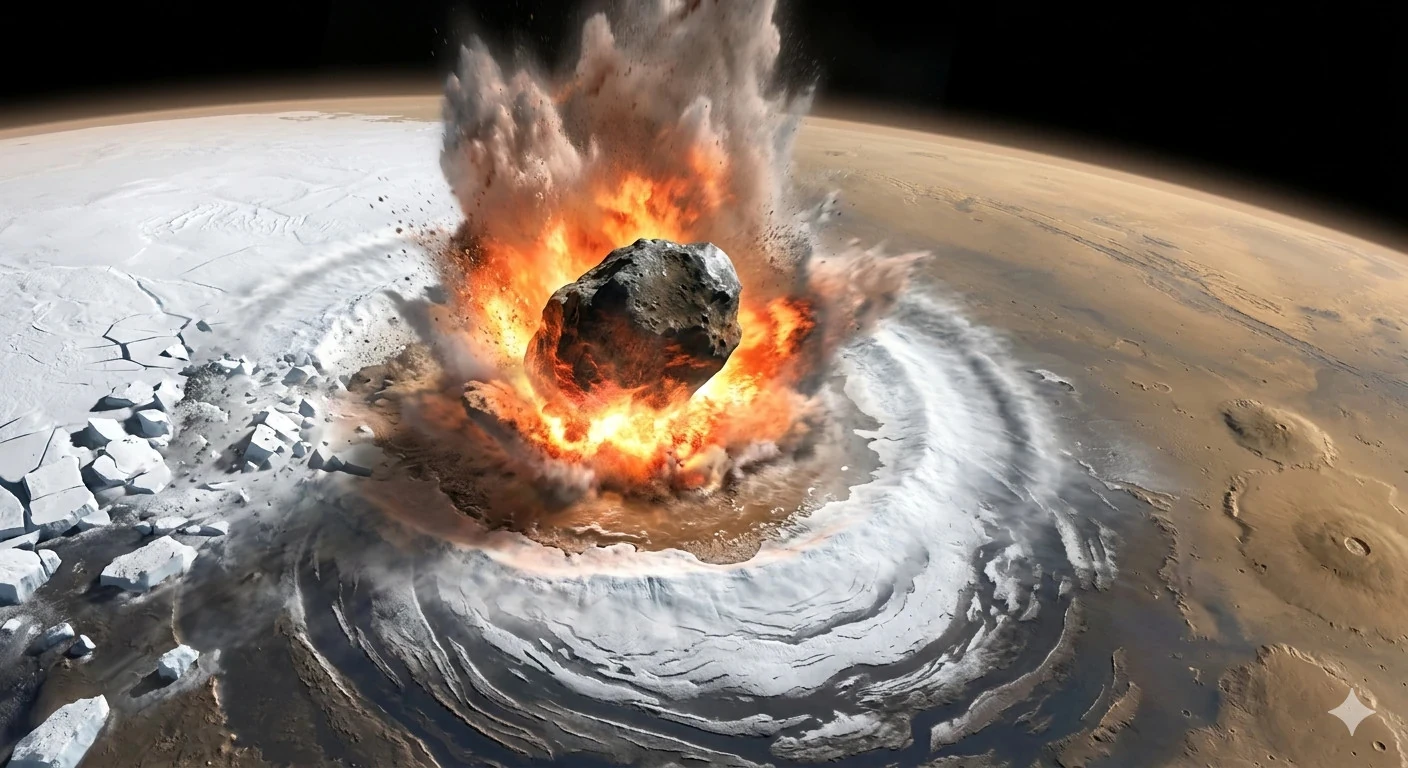
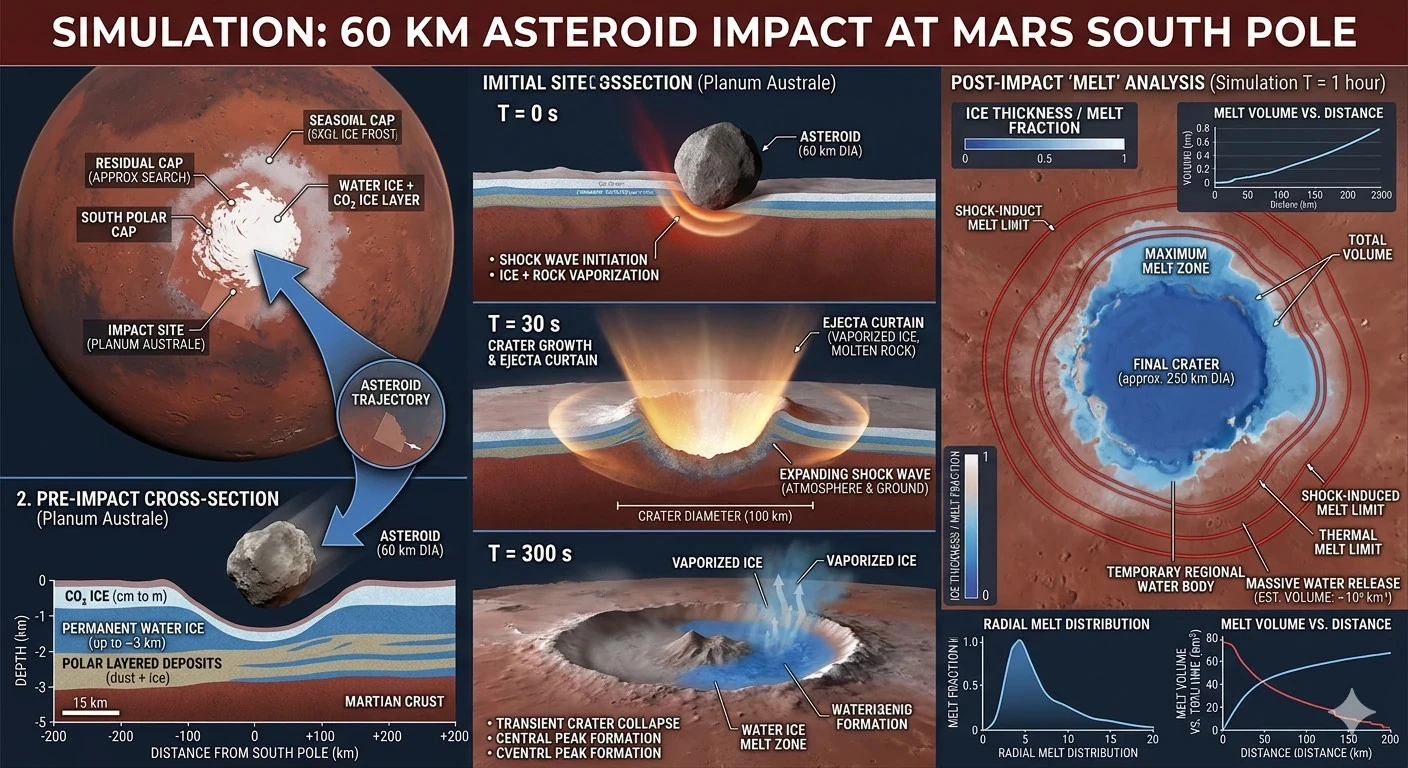
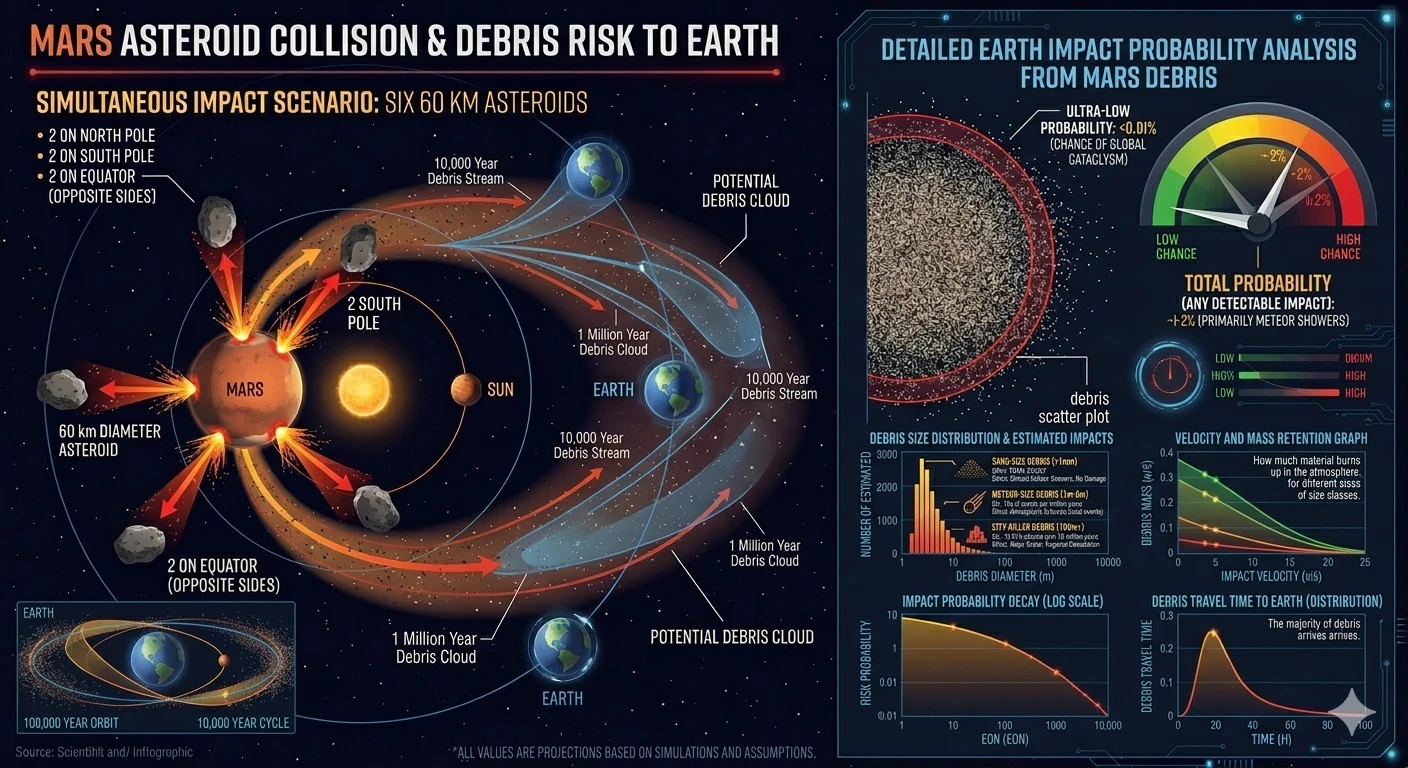
According to Artificial Intelligence simulation, the most promising method to terraform Mars is to hit into a Mars six asteroids with radius 60 Km (every asteroids). Two into South pole, two into North pole and two on opposite sites of Equator. Jupiters gravity would pull most of the debris from inner planets in the solar system. The one crater after hit of such a asteroid might have radius of 250 km. The dust generated by hits would generate additional greenhouse effect.
Full article:
According to Artificial Intelligence simulation, the most promising method to terraform Mars is to hit into a Mars six asteroids with radius 60 Km (every asteroids). Two into South pole, two into North pole and two on opposite sites of Equator. Jupiters gravity would pull most of the debris from inner planets in the solar system. The one crater after hit of such a asteroid might have radius of 250 km. The dust generated by hits would generate additional greenhouse effect.

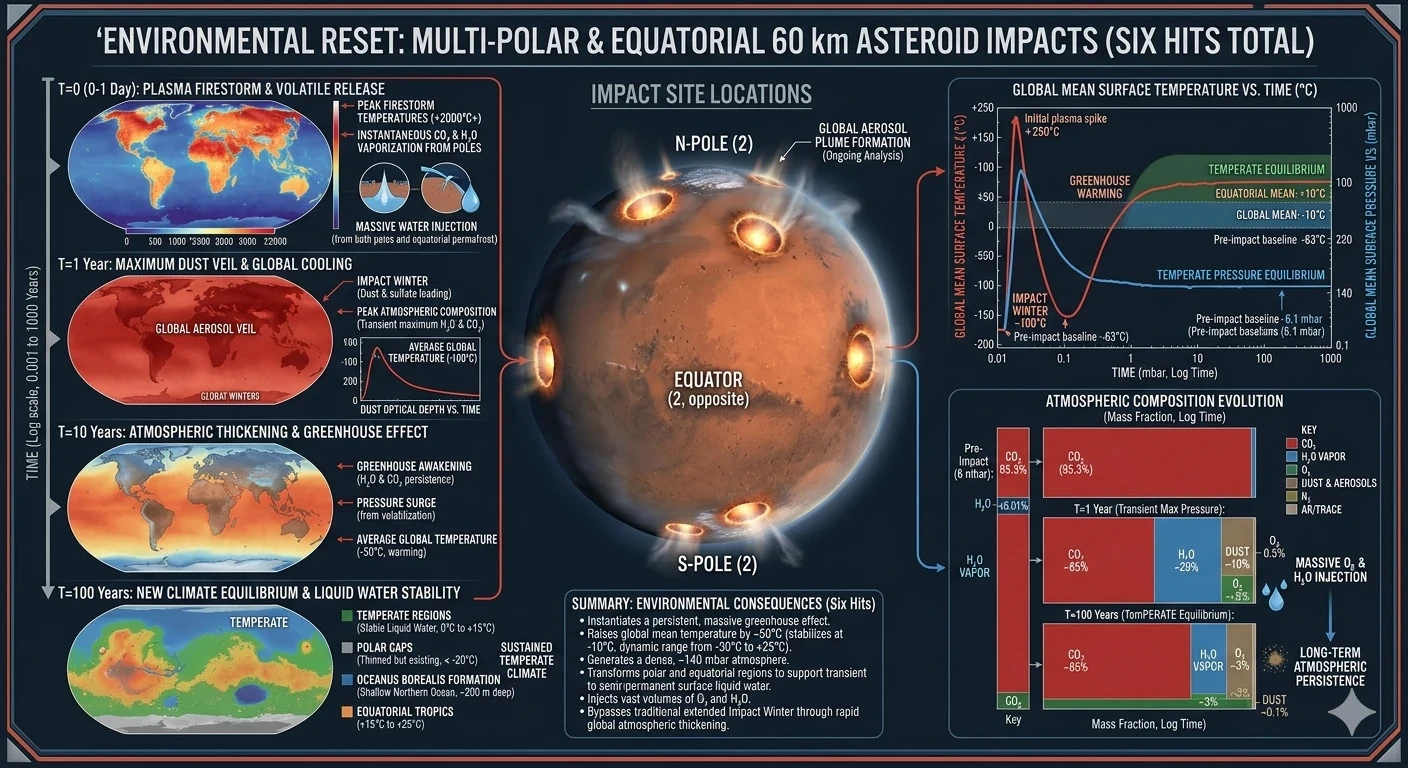
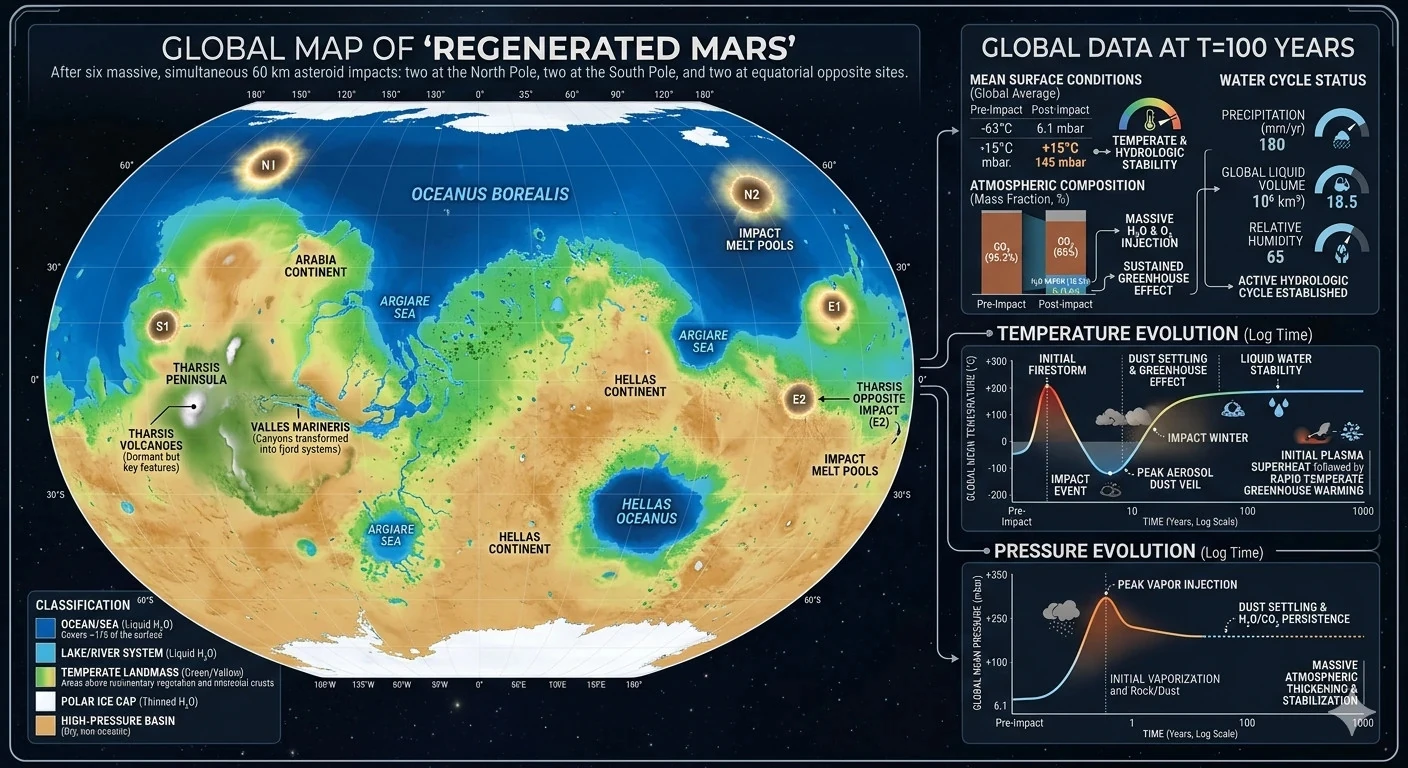
The North pole and South pole of the Mars are covered with an ice which is frozen carbon-dioxide and water. During an explosion these would evaporated creating an atmosphere rich in oxygen which would be increased directly after hit up to 5.1 % pressure would be 145 mBar and water vapor of the atmosphere would reach 12 %. This would take place 100 years after impact. In effect of explosion most of the north sphere of the Mars would covered a liquid water - 1/3 of the planet. Mean temperature of the planet would be a +15 C degree. Most of the atmosphere at that point would be still a carbon-dioxide – 85%.

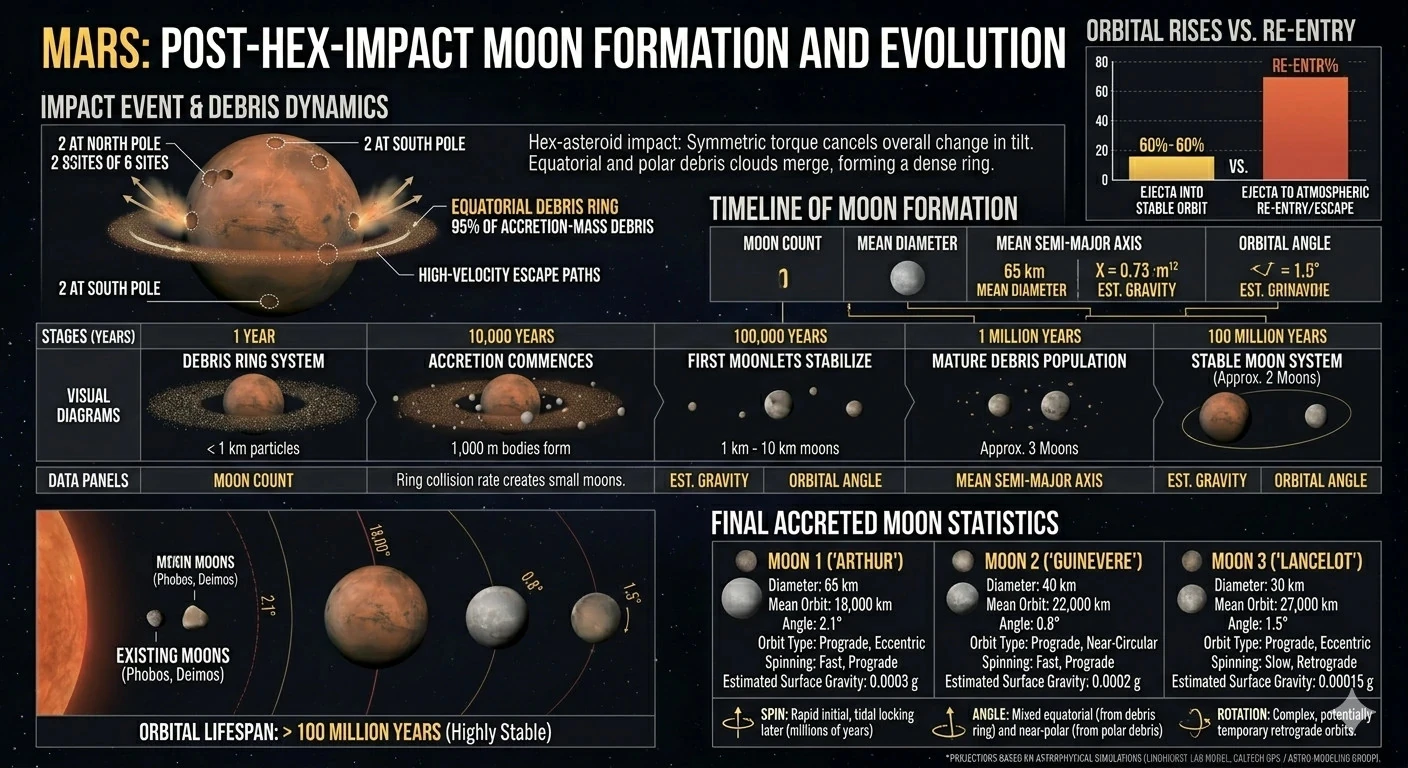
The impact would have create debris field around Mars from which would form at least 3 additional Moons with a radius from 65 Km to 30 Km on orbit raging from 18 000 km to 27 000 Km. The first debris would have a chance to hit planet Earth within 10 000 years with probability level has been calculated up to 0.001 %. Most of the debris from collision would have re-enter a planet Mars and the rest would remain on stable orbit forming possibly a ring. Within 100 000 years, surrounding a Mars space would be nearly completely clean from debris leaving additional Moonlets – objects with a range from 1 to 10 Km. The axis of the planet would change from 25.19o to 25.17o or 25.21o and the day would have extend from 24h 37m 22s to 24h 37m 23s. Orbital period would stay the same which is 687 days.

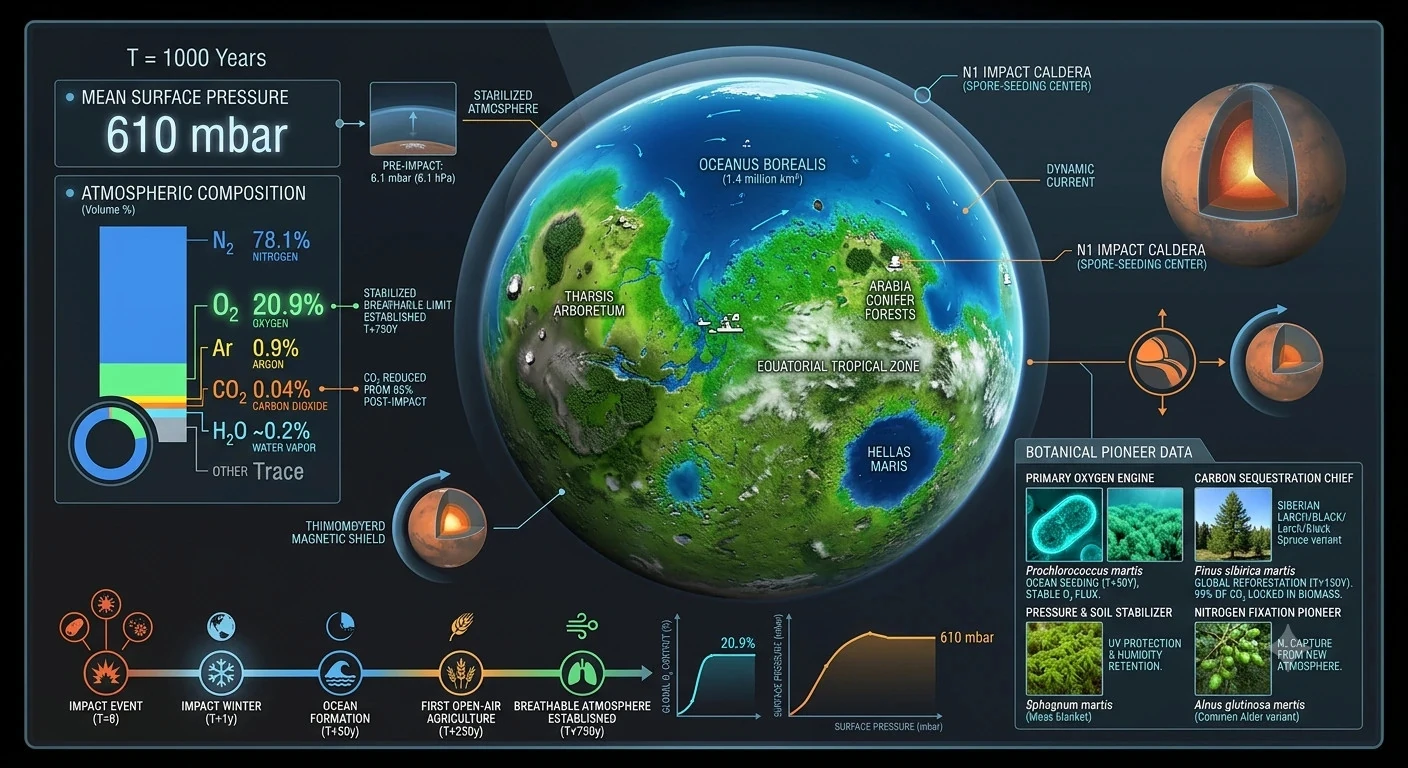
Even though this is significant improvement comparing to ongoing conditions on Mars – mean temperature -63 and pressure 6.1 mBar, and the fact that people would be able to thrive in this environment only with oxygen masks, without pressurized suits, this would not create a condition strongly similar to Earth’s one. Further terra-formation process would require to bring on Mars microorganism and plants which would eventually within 1000 years increased a pressure to 610 mBar and Oxygen level to 20.9 %. At that point (after 1000 years) most of the atmosphere would be Nitrogen 78.1 % replacing carbon-dioxide which would be left at level 0.04 % plus minor traces of Argon 0.9% and water vapor 0.2%. On the planet there would be a seasons like on Earth – spring, summer, autumn and winter with a snow fall and rainfalls. Mean temperature in winter would be raging from -15 C to -10 C. In Spring mean temperature would be + 18 C. In Summer mean temperature would be 25 C degree and in Autumn mean temperature would be 15 C degree.

To achieve this effect would be necessary to bring on Mars after crashing these asteroids following plants and microorganisms:
- in oceans and water reservoir - Arthrospira platensis (Spirulina), Prochlorococcus. This spacious, cyanobacteria produce 50% of Earth's O2 and will thrive in the mineral-rich Martian seas.
- in the ground (Soil Builders) Alnus viridis (Green Alder), Trifolium repens (Clover). This spacious converts atmospheric N2 into soil nitrates, essential for supporting more complex "Earth-style" crops.
- CO2 Scrubbers (removers of CO2) - Bambusoideae (Giant Bamboo), Miscanthus x giganteus. C4 plants process CO2 at ultra-high speeds, "locking" carbon into their stalks.
- Radiation Shielders (UV radiation). Syntrichia caninervis (Desert Moss). Mosses protect the soil from UV and hold moisture in the low- pressure air.

Due to high level of the CO2 at the begging farming would be performed under non-pressurized transparent poly-tunnels. Closer to 1000 years after asteroids crash, less such a poly-tunnels would be needed because different plants are handling worst or better with a low pressure and high level of CO2. Low pressure cause water to evaporator faster and such a tunnels would help to create microclimate. One of the first vegetables which would growth on Mars would be a potato due to high caloric density and tolerance for soil quality.

“
• Years 100-200: Global seeding of oceans with algae. Oxygen rises from 5% to 8%.
• Years 200-500: Massive Conifer reforestation (Siberian Larch/Black Spruce). CO2 levels drop significantly as forests "consume" the air.
• Year 1,000: Atmospheric pressure stabilizes; CO2 is reduced to <10%. Oxygen levels reach
~18%. Mars becomes "Breathable" for humans with simple filtration masks.
“

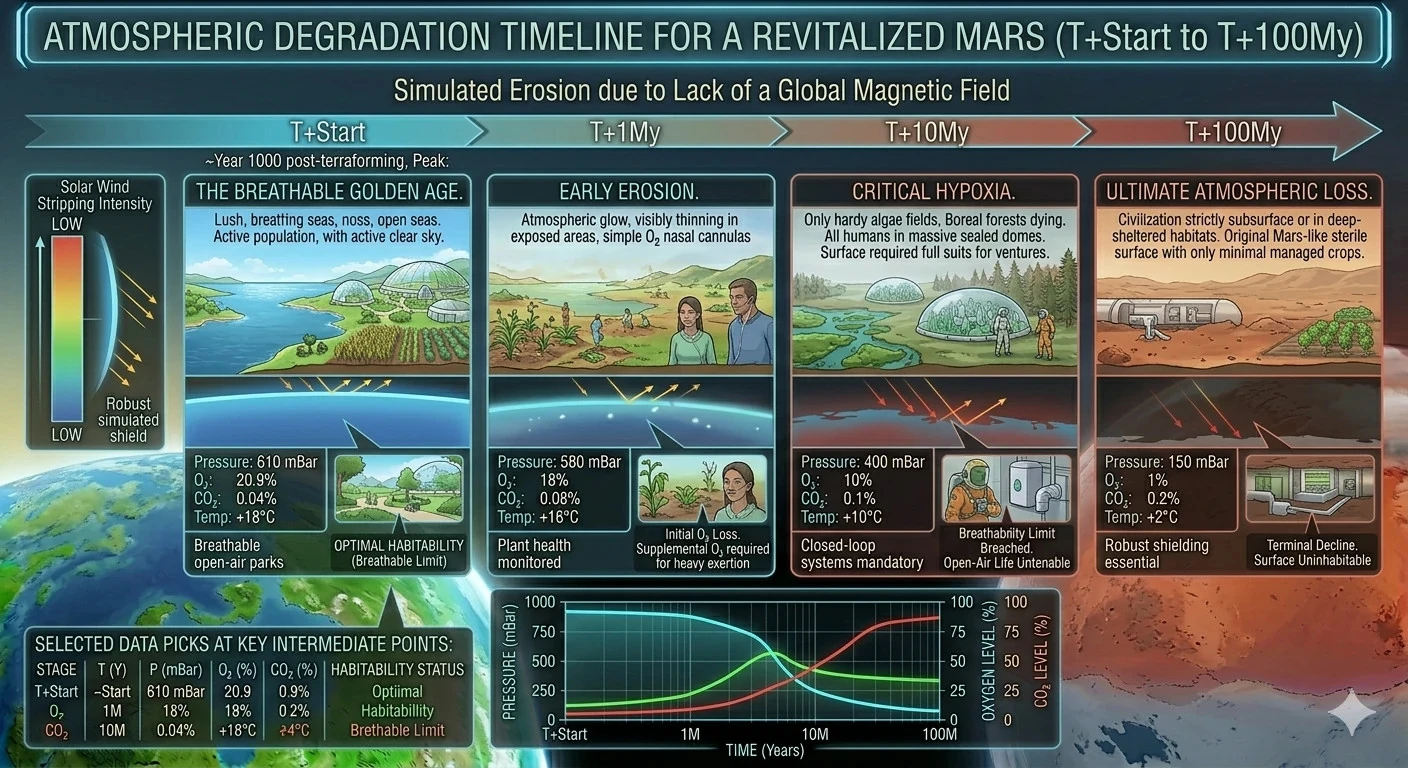
Such a revitalized Mars could thrive in with an oxygen level at least 20 % and pressure 610 mBar for about a 1 million years. After 10 million years the symptoms of atmosphere lost would start affect bio organism on the planet. Because of lack of magnetic field solar wind would slowly blow an atmosphere.

Based on the Artificial Intelligence Simulation can be said that Humans would have adopted to lower pressure (610 mBar) on Mars. Over generations a lungs of Humans would have expanded to stabilize deep regular breathing. RBC (Reb Blood Cells) count would increase along hemoglobin. It has to be remembered that lower pressure can cause dehydration so consumption of the water would be higher by Humans in such a environment. Lower pressure can cause also a cognitive problems at the beginning. The smell and taste would have reduce and Humans would be more altered due higher sensation of acoustic perception. In summary Marsian’s life would be like on 4000 meter height mountain/peak.

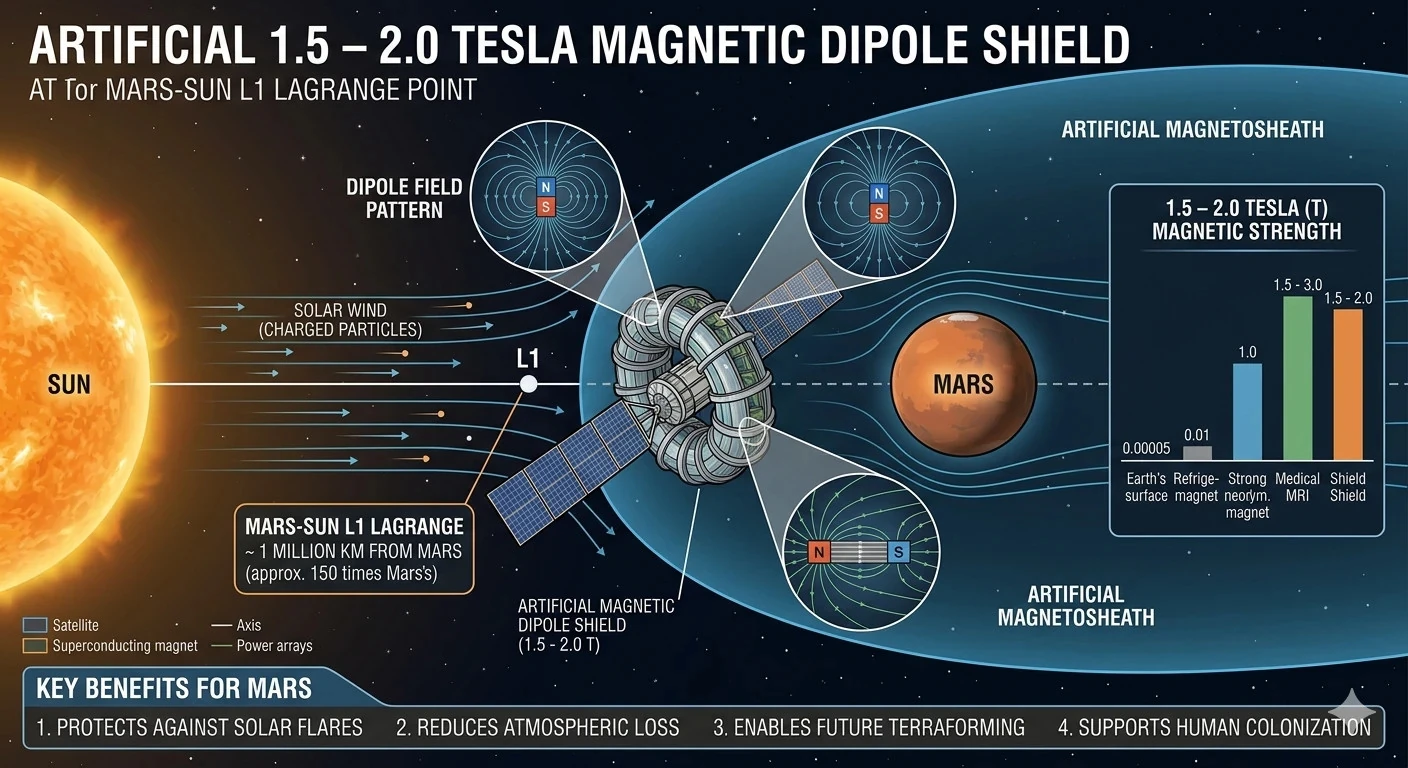
Finally, Losing atmosphere by Mars can be resolved by designing artificial satellite and deploying it at distance 1 mln km from Mars. This satellite would generate an artificial magnetic field 1.5 to 2.0 Tesla and cover a space 150 bigger than Mars. It would need to be positioned always in front of Mars within distance 1 mln kilometers and 1.5 to 2.0 Tesla field. The magnetic field generator dimension would be 12 km radius in diameter and 300 m.

However it has to be underlined that with nowadays and near future technology it might be difficult to build such a, artificial generator of magnetic field, today and in the future, but does not mean is not possible.

The artificial intelligence simulation should be treated as a baseline for a process of terra-formation of Mars and they might have require further studies, but evidently are showing that terra-formation of Mars is realistic with currently available technology and human civilization development level.

The video attached to this article show detailed information about terra-formation process proposed by an AI and potential dangers. Due to current limitation of this platform there is no way to attach more than 12 pictures per article therefore they are included in a video - 41 illustrations and report pages has been included into a video - every 10 seconds.

Documentation has been added on 6.6.2026 under link: "Documents on DropBox" in links section

Second documentation has been added on 21.6.2026 under link: "Red Retti Cloud Files Storage" in links section
MEDIA SECTION:
Gallery:
0.webp)
0.webp)
0.webp)
video:
Sources:
Google Gemini Documents on DropBox Red Retti Cloud Files Storage